
Video Translator App: Which Kind You Need and What Works on a Phone
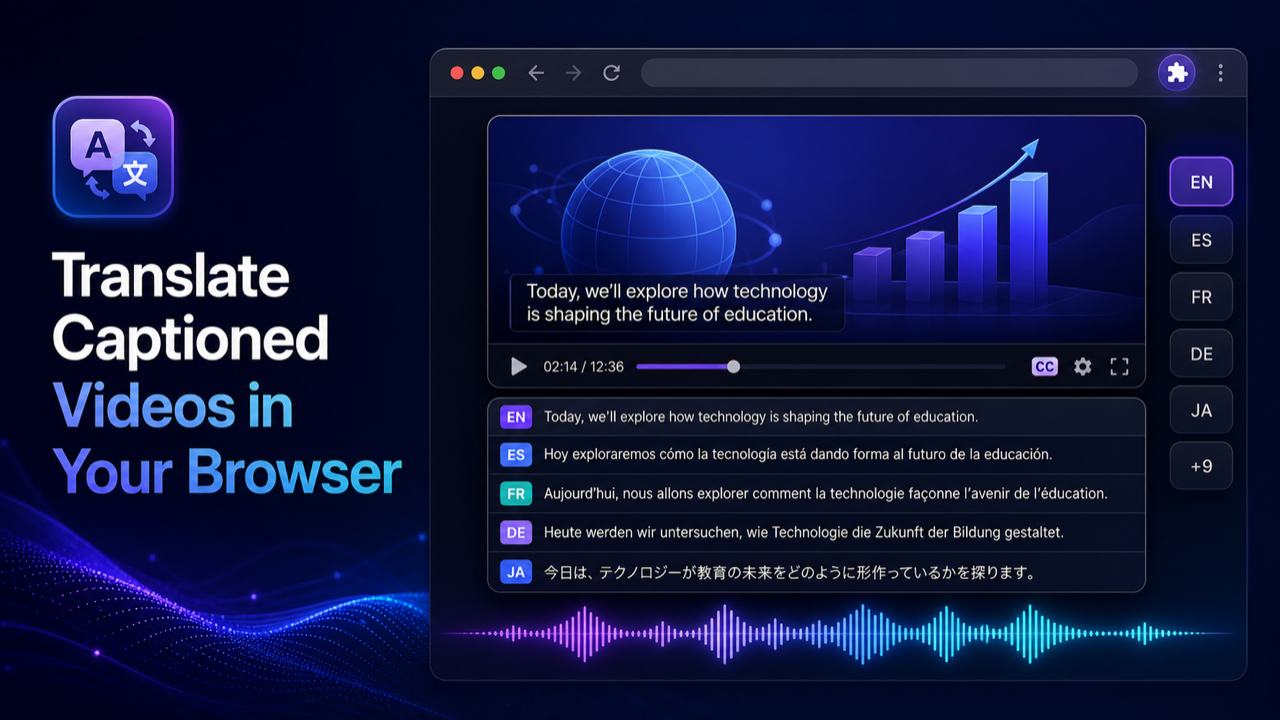
When someone types video translator app into a search box, they usually have one video in front of them and one question: how do I follow this in my language. Four different kinds of software get sold under that label, and they do not do the same job. Pick the wrong kind and you end up uploading a file to a service that wanted a link, or trying to install a browser extension on a phone that cannot run one.
I build one of the four, so I have an interest here. I will say which one and what it cannot do, then spend the rest of the page on the question the search is really asking.
The four things sold as a video translator app
A phone app that processes a file. You record a clip or pick one from your camera roll, the app uploads it, runs speech recognition, translates the transcript, and gives you back a version with subtitles burned in or a new voice on top. Right when you own the clip and want to post it somewhere else. Wrong for a lecture on a course site, because you do not have the file.
A desktop or web pipeline that renders a localized file. The same stages with more control: transcript editing before translation, a choice of voices, sometimes a subtitle editor and export in several formats. This is what a creator or a training team uses when the result has to be published. Processing time and per-minute pricing are the trade.
A platform's own subtitle translation. YouTube, Coursera and Udemy each translate captions to some degree, free, with nothing to install. Coverage depends on the video having a caption track and on the platform offering your language for that particular video.
A browser extension that translates the player in the tab. The extension reads the caption track the page already exposes, translates that text, and either shows it as subtitles or speaks it with an AI voice over the original audio. Nothing is uploaded and nothing is rendered. You get no file. This is for watching, not publishing.
The one I work on is the fourth kind. Unlimited Universal Video Translator is a desktop Chrome extension, not a mobile app, and it cannot be installed on a phone. It only works when the video already has captions. It does not transcribe audio, import or export subtitle files, clone anyone's voice, or produce a translated video file. If you need any of those, you need one of the first two categories.
If you came here to compare products by what they hand you at the end, the best video translator app comparison already does that, sorted by output type. This page stays on the question underneath it: which kind of thing do you need, and can you do it on the device in your hand.
Match the kind to the job
An app to translate a video you recorded yourself is a file processor, category one or two. An app to translate video that lives on a course site or on YouTube is category three or four, because the file never touches your device. The dividing line is that simple: do you have the file, or do you have a page.
A second line splits the same four by what you want back. If the answer is "a video I can post", only a renderer will do. If the answer is "I want to follow this lecture tonight", a caption translator, built into the platform or running in an extension, is the whole solution. My guess is that most people looking for an app that translates videos are in that second group: they have a captioned video open and want it in their language before it ends. Category three costs nothing and is worth trying first. Category four is for when the platform lacks your language, or when you want to hear the translation instead of reading it.
Can I translate a video on my phone
Yes for some paths, no for others.
On iOS, Apple documents that the system can generate synced subtitles during video playback in supported apps, and that it can translate existing captions on the device when you have more than one preferred language set. Live Text and the Translate app read text in a photo or in a paused video frame, so a slide or a street sign can be translated by pausing on it. In the YouTube app the path is the CC icon, then Captions, then Auto-translate, then your language. That menu only appears when the video has a caption track, including an auto-generated one.
Every one of those gives you text. None of them dubs spoken audio into a new voice. If what you searched for was a voice video translator app, the native tools on a phone do not answer it. You are looking at a file-processing app that uploads the clip and sends back a dubbed version, which only works for clips you have as files.
On Android, the extension route is closed. Chrome for Android has never supported extensions. Kiwi Browser, which used to run Chrome extensions on Android, was discontinued in January 2025 and removed from Google Play. Edge on Android supports extensions only in the Canary channel and only from the Edge Add-ons store, not the Chrome Web Store, and the support is experimental enough that some extensions crash. Firefox for Android installs WebExtensions from addons.mozilla.org with a limited API surface. A Chrome Web Store extension is not a phone option in any of these. The YouTube app's Auto-translate path works the same on Android as on iOS.
So the plain answer to can i translate a video on my phone: translated captions, yes, when the app you are watching in supports them and the video has a track. A dubbed voice, only through a file-processing app and only for files you own. A browser extension, no.
What to check before installing any app to translate videos
The best video translation app for one person is useless for another, because "best" depends on which of the four kinds fits the job. Instead of a ranking, here are the questions I would put to any listing before tapping install. They apply to my own extension too.
Does it want the file or the page? A listing that says "upload" or "import from camera roll" is a file processor. One that says "works on YouTube" or "in your browser" is a page tool. One of them matches the video you have and the other does not.
Does it transcribe, or does it read an existing caption track? Transcription means it will handle a video with no captions at all. Caption reading means it cannot, and any app that can translate video language only from an existing track should say so on the listing. Mine is in the second group. A best video language translator app search surfaces both kinds side by side, and the listing rarely makes the difference obvious.
Does it hand you a file? If you need to post the translation, you need an export. If you only need to understand the video, an export is something you will pay for and never open.
What permissions does it ask for? A phone app for translating your own clips needs the camera roll and nothing else. A browser tool needs the pages where the video plays. An app to translate video language that asks for contacts or location deserves a second look.
What is metered on the free tier? Minutes, videos, languages, or features. The next section explains why this matters more than the star rating.
Run those five questions against a listing and the best app to translate videos for your situation usually picks itself. The best video voice translator app for a clip you filmed is a renderer with a voice you like. The best app for video translation of a course you are enrolled in is whichever tool reads that platform's caption track. Apps that can translate videos in both situations exist, but they charge for the rendering part whether you use it or not.
The free tier reality
Speech recognition and speech synthesis both cost compute per minute of audio, and the provider pays for every minute whether you are a paying customer or not. That is why free tiers in this category cap minutes, cap the number of videos, or watermark the output. Searching for an ai video translator app free shows plenty of listings with "free" in the title; the number to find is how many minutes per month that word covers.
When a free tier caps features instead of minutes, read it as a signal. If the free plan has unlimited subtitle translation but the dubbed voice is paid, the expensive part is synthesis and the cheap part is text. If the free plan translates text but transcription is paid, the expensive part is recognition. The best free video translator app is the one whose free part is the part you actually need.
Caption-based tools have an easier time here because they skip recognition entirely: the text already exists, and translating text is far cheaper than transcribing audio. That is why a browser extension can be free to start with a paid unlimited tier, while file processors more often start counting minutes on day one. It is also why the caption-based route cannot help with a video that has no captions.
Apps that translate videos to english
English is the most common target, and the search phrasing is different. People looking for apps that translate videos to english usually want subtitles they can read fast, in a language they partly know or not at all.
Try the platform route first: YouTube's Auto-translate offers English for any video with a caption track, and a course platform may already have English captions. An app to translate videos to english that you pay for is the fallback when the platform has no track or the machine caption is too rough to follow. In that case check whether the paid app transcribes, because a rough auto-caption is still the input a caption-based tool would translate.
Related guides
For the mechanics of the caption-reading route, AI Video Translator walks through detection, translation and speech. How to translate a video compares the file and page routes end to end. If the video is a file on your phone, how to translate a video on iPhone and Android live translate video cover what each system does natively. See also free video translator and, for desktop, video translator Chrome extension.
Frequently asked questions
Is there a video translator app for iPhone that dubs the audio?
Only the file-processing kind. Apple's own tools generate and translate captions and read text in a paused frame, but they do not replace the speaker's voice. An app that returns a dubbed clip uploads the file first, so it works for videos in your camera roll and not for a lecture playing in a browser.
Can I install a Chrome video translator extension on my phone?
No. Chrome for Android has never supported extensions, Chrome on iOS uses WebKit and supports none either, and Edge on Android installs extensions only from its own store in the experimental Canary channel. The extension I build is desktop Chrome only and there is no mobile version.
Do I need an app at all if the video is on YouTube?
Often not. In the YouTube app on iOS and Android, tap the CC icon, then Captions, then Auto-translate, then your language. It appears only when the video has a caption track, including an auto-generated one, and it produces translated subtitles rather than a dubbed voice.
What does an ai app to translate video do that the platform does not?
Depends on the kind. A file processor gives you a rendered video with a new voice or burned-in subtitles that you can post elsewhere. A browser extension gives you a spoken translation on top of a captioned video, which the platforms themselves generally do not offer. For plain translated subtitles on a captioned video, the platform is usually enough.
Which kind of app works for a video with no captions?
Only one that transcribes: a phone file processor or a desktop rendering pipeline with speech recognition. Platform subtitle translation and caption-reading extensions both need an existing track. Check the listing for the word transcription before paying.
Other ways people search for this
The same four categories get searched under a lot of names, because people describe the job by the thing they expect to install. Someone who calls it a video translation app or an app for video translation usually means the file-processing kind. Someone who writes ai app translate video or ai video translation app is thinking of the model doing the work rather than the app wrapping it, and gets the same four kinds back. Apps for translating videos and an auto translate video app both describe the wish that the software picks the language and does the rest, which is what the platform route and the extension route do when a caption track exists. None of these phrasings changes the answer: decide whether you have a file or a page, then whether you need a file back, and the category follows.