
AI Video Translator GitHub Route: What Self-Hosting Actually Costs
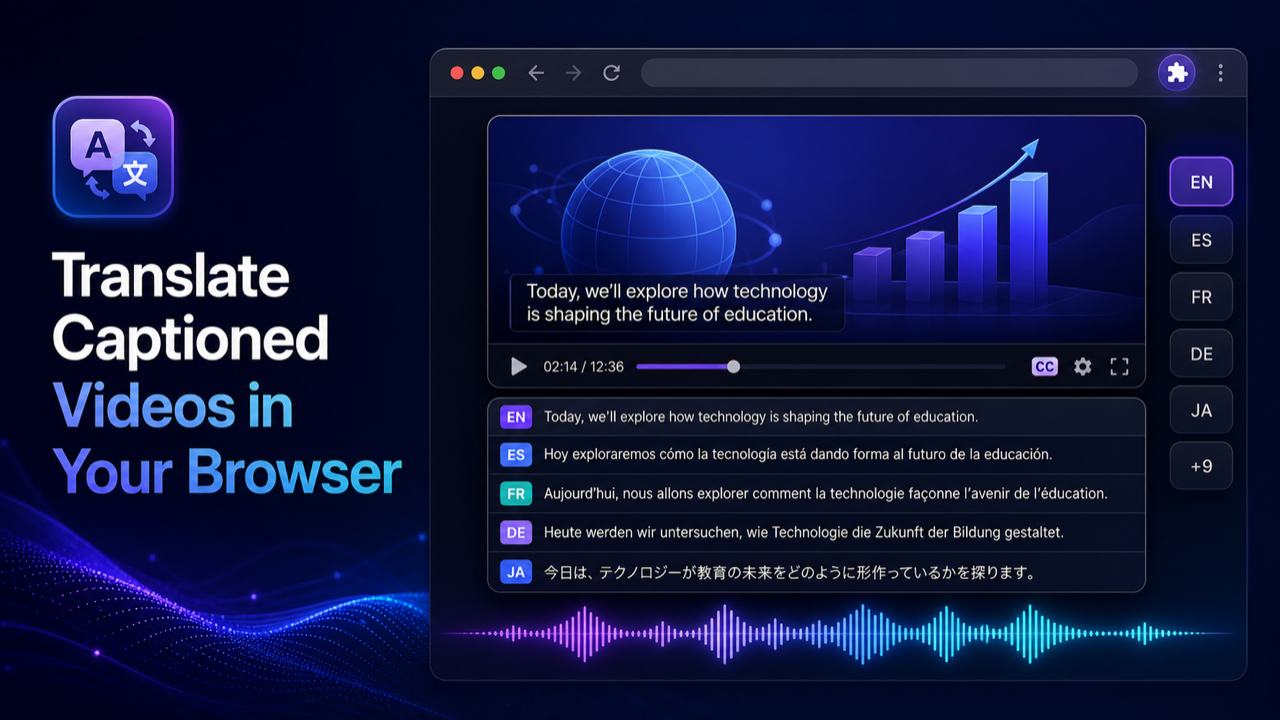
Typing ai video translator github into a search box is a decision, not a question. You have already ruled out paying per minute, and you want the pipeline on hardware you control. This page is about that route: the stages a self-hosted stack has to cover, the bill nobody puts in a README, where the output is genuinely good and where it is audibly not, and the licence detail that decides whether you may ship anything you produce.
One thing first, because it saves you a click. The extensions I build are closed source. There is no public repository for them, and there will not be one. If an open repo you can fork, audit and run on your own box is the requirement, this is not it, and the rest of this page is about the route that is.
What people are really asking for
The word github in that query stands in for four different requirements, and it is worth knowing which ones are yours before you spend a weekend.
No per-minute bill. Hosted translation charges by video length. Once your archive runs to hundreds of hours, a fixed cost you already paid for starts to look better than a meter.
No upload of confidential material. Unreleased product footage, internal training, recorded customer calls, anything covered by a contract that names where data may be processed. A local pipeline means the media never leaves your network, and you can say that in writing.
Full control over the parts. You pick the recognition model, you fix the terminology, you decide what happens to a segment the model got wrong, and nothing changes under you because a vendor shipped an update.
An API instead of a user interface. A hosted tool that only works through a browser cannot be called from a queue worker. A local pipeline is a command you can put in a script, and that is often the entire reason for the search.
If your list is only the first item, check the arithmetic before you build. Hardware plus your own time is rarely cheaper than a subscription until volume is real.
The four stages any self-hosted stack has to cover
There is no single program that does this. Every repository in this space is a wrapper around the same chain, and understanding the chain lets you judge any wrapper in ten minutes.
Audio extraction and demuxing. Pull the audio out of the container and hand it to the next stage as a plain waveform, usually 16 kHz mono. ffmpeg does this, and it is the one dependency you can rely on being present, documented and stable. This stage is cheap in compute and is where broken files surface early: variable frame rate, misreported duration, an audio stream the container claims is one codec and is not.
Speech recognition. The audio becomes timed text. OpenAI released the Whisper weights openly, which is why so much of this ecosystem is built on top of them; the model family runs locally and produces segment timings alongside the transcript. This stage is the expensive one in compute and the one that decides everything downstream, because a misheard term propagates through translation and into the spoken output.
Machine translation. Timed source text becomes timed target text. Cheap relative to recognition, and the place where segment boundaries start to hurt: a sentence split across three caption cues gets translated three times without context unless your pipeline reassembles sentences first and re-splits afterwards.
Speech synthesis. Target text becomes audio. Cost depends heavily on the model, and this stage also has to solve timing, because the translated line rarely lasts as long as the original. You either stretch, compress, pad with silence, or accept drift. Skipping this stage entirely and shipping subtitles is a legitimate answer and a much easier one.
Muxing or subtitle output. ffmpeg again, either writing the new audio track into the container or writing a subtitle file next to it. Mechanically simple, easy to get wrong in the details: track language tags, sample rate mismatches, and whether you replaced the original audio or added a second track.
Those five boxes are the whole job. Any project you evaluate is a set of choices inside them plus glue, and the glue is usually what breaks.
The cost that repositories do not advertise
The install command is free. What follows is not.
GPU hardware or rented GPU time. Recognition and synthesis at usable speed want a GPU. Buying one is a capital cost that sits in a machine doing nothing between jobs. Renting one means an hourly meter, which is the thing you were trying to escape, except now you also maintain the stack. CPU-only inference works and is slow enough that it changes what you are willing to process.
Model download size and VRAM. Larger recognition models are more accurate and want more memory; the largest ones do not fit on a modest consumer card. You will discover your real ceiling the first time a job dies out of memory halfway through a two-hour recording. Plan capacity around your longest file, not your average one.
Throughput against video length. The number that matters is processing time divided by media duration. Under one means faster than real time. Well over one means a lecture takes longer to translate than to watch, which is fine for an overnight batch and useless for anything interactive. Measure it on your own hardware with your own files, because published numbers were measured on someone else's.
The maintenance tax. This is the cost people underestimate by the widest margin. A pipeline is a stack of Python packages, CUDA versions, model formats and ffmpeg flags. It works the day you build it. Six months later a dependency has changed an API, a model format has moved, and the environment that used to install cleanly does not. Budget recurring hours, not a one-time build.
What quality actually looks like
Set expectations by stage, because they are not equal.
Open speech recognition on clean audio is good. A single speaker, a decent microphone, a lecture or a screen recording, and the transcript is close enough that correcting it is faster than typing it. Degrade the input and it degrades fast: overlapping speakers, background music, heavy accents, phone-quality audio, and the error rate climbs where you can least afford it.
Machine translation is adequate. Meaning survives, register wobbles, idioms land oddly, and anything domain-specific needs review. For understanding a video, adequate is enough. For publishing a translation under your name, it is a first draft.
Open speech synthesis is where the gap to commercial output is most audible. The words are right and the delivery is flat: prosody, emphasis and pacing across a long passage are where paid voices still pull clearly ahead. Listen to five minutes of your candidate output before you commit to a plan built on it, not five seconds.
Terminology control needs a glossary you build yourself. Across a ninety-minute video, a product name or a technical term will be rendered three different ways unless something forces consistency. No stage does this for you. Build a do-not-translate list and a preferred-term map early, apply it between translation and synthesis, and keep it in version control next to the pipeline.
When self-hosting is the right call
It is the right call when the material legally cannot leave your infrastructure. If the contract or the regulation names where processing happens, the decision is already made and cost is secondary.
It is the right call at high volume. There is a crossover point where hardware plus maintenance beats per-minute pricing. Work out where yours sits by taking your monthly hours of video, pricing them at a hosted rate, and comparing against hardware amortised over a couple of years plus honest hours of upkeep.
It is the right call when you need an API rather than an interface. Translation as a step inside a larger system, triggered by an upload and writing into a bucket, is not something a browser tool can do.
It is the wrong call when one person wants to watch one lecture tonight. The setup alone outlasts the video. That case is why in-tab translation exists.
Licences, which people skip and should not
Two separate licences apply, and reading only one is the standard mistake.
The repository licence governs the code: whether you may use it commercially, whether you must publish your changes, and what you owe if you redistribute. Permissive terms and copyleft terms lead to very different obligations once output leaves your own machine.
The model weights carry their own licence, and it is frequently not the same one. Weights are distributed under terms that can restrict commercial use, restrict certain applications, or require attribution, regardless of how the surrounding code is licensed.
A permissively licensed repository wrapping restricted weights is the trap. The badge on the README says one thing; the file you downloaded into the models directory says another, and the restrictive one binds. Read both, for the code and for every model in your chain, and if money or redistribution is involved get a lawyer to read them too. I am describing where to look, not giving legal advice.
The honest comparison
In-tab caption translation is the opposite trade to everything above: zero setup, zero control.
Unlimited Universal Video Translator is a Chrome extension for desktop that reads the caption track a page already serves, translates it, and plays AI text-to-speech over the original audio or shows translated subtitles. No GPU, no model downloads, no dependency upkeep. In exchange you get none of what the self-hosted route is for: no access to the pipeline, no file in and no file out, no transcription when the page has no caption track, no API, and no source code to audit.
That is the right answer for watching, and only for watching. If the output has to be a file you ship, or the material cannot leave your network, or the job runs inside a system, build the chain described above and pay its real price with your eyes open.
Related guides
AI Video Translator covers the recognise, translate, speak chain without assuming you will host it. How to Translate a Video walks every route from player settings to full production. Video Translation Services is the page for handing the work to people instead of machines. Best AI Video Translation Tools 2026 compares the hosted category, and Translate Video to Text deals with transcript output specifically. For long files on a budget, see long video translator free.
Frequently asked questions
Is your extension open source and on GitHub?
No. The extensions I build are closed source and there is no public repository for them. If auditing or forking the code is a requirement, use the self-hosted route described on this page instead.
What is the minimum I need to run a local video translation pipeline?
ffmpeg for audio extraction and muxing, an open speech recognition model such as Whisper, a translation step, and either a subtitle writer or a synthesis model. A GPU is optional but decides whether processing is faster or slower than real time.
Can I run this without a GPU?
Yes, and it will be slow. CPU inference on a long recording turns a coffee break into an overnight job, which is workable for batch processing and not for anything you are waiting on.
Why is the synthesised voice the weakest part?
Recognition and translation have had far more open investment than expressive synthesis. Open voices get the words right and the delivery flat, and over a long video that flatness is what listeners notice first.
Do I need to check the licence if I only use it internally?
Internal use is the least risky case, and it still depends on the terms. Read the repository licence and the licence on every model you download, since the two are often different and the restrictive one governs.