
Long Video Translator Free: Quotas, Length Caps and What Breaks
Free tiers in this category are sold in minutes, and one long recording swallows a month of them. Thirty free minutes is enough for a product demo. It is not enough for a 96-minute conference talk, and it is nowhere near enough for week three of a course where every lecture runs past an hour. Anyone typing long video translator free into a search box has usually already watched a progress bar stop at the cap with forty minutes of the talk left.
So this page is about length and the meters attached to it. What makes a long file expensive, what the word free is actually covering in each plan, what unlimited can honestly mean, and what goes wrong on a three-hour recording no matter who is paying.
Minutes are the unit, because minutes are what costs money
Every machine step in a translated video is billed against the duration of the audio, not the size of the file.
Speech recognition runs on the audio in something close to real time, so a two-hour lecture is roughly 120 minutes of recognition work. Machine translation is billed on the text that comes out of that, and a talkative speaker produces around 130 to 150 words a minute, which is why a long video also means a long bill on the translation step. Speech synthesis is priced the same way, per character or per minute of generated audio, because the model has to produce every second of it. And if the service hands you a finished MP4, there is a rendering pass on top, which is GPU time per minute of output.
Four meters, all of them proportional to duration. That is the whole reason a free tier can be generous about the number of videos and stingy about their length.
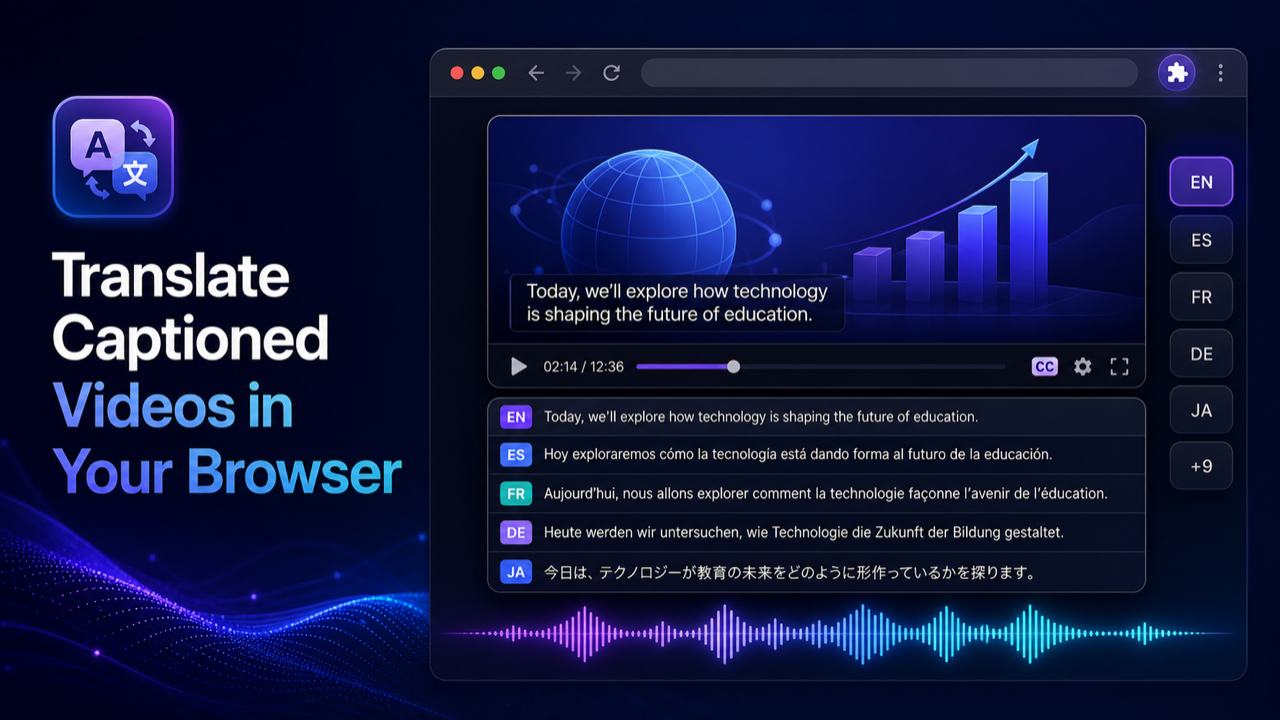
Caption-driven translation inside the browser tab removes the first meter entirely. It reads the caption track the page already serves, so nothing has to listen to the audio, and it plays the result over the video instead of rendering a file, so nothing has to be encoded either. What remains is translating caption text and speaking it, which still scales with playback time, just from a much lower base. A flatter cost curve still costs something. What it buys is the gap between a lecture being cheap to translate and a lecture being expensive to translate.
The five shapes a free tier takes, and what each does to a long file
"Free" hides five different limits, and they fail in completely different ways when the video is long.
| Limit | How it shows up | What it does to a two-hour file |
|---|---|---|
| Minutes per month | A credit balance, often 10 to 60 minutes | One video consumes the month, sometimes stopping mid-sentence |
| Per-file length cap | An upload rejected before processing starts | Nothing runs at all until you cut the file up |
| Watermark | A logo on the exported video | Survivable, but you are exporting a file you cannot show anyone |
| Queue priority | Free jobs wait behind paid ones | The wait scales with length, so hours-long files sit longest |
| Feature cap | Free gets subtitles, paid gets voices, or free gets one language | You finish the job and discover the output is not the one you wanted |
Check which one you are facing before you start a three-hour recording, not after. Three checks cover it. Open the pricing page and look for the word minutes rather than the word videos, because a plan that counts videos is usually hiding a length cap elsewhere. Look for a maximum duration or maximum file size in the upload help, which is where the per-file cap is normally written down. Then run a five-minute clip first and read what the balance says afterwards, because that number tells you the real exchange rate better than any pricing table.
A tool that will not tell you the unit before you upload is telling you something anyway.
What "ai video translator free unlimited" can honestly mean
The phrase ai video translator free unlimited is searched by people who have done the arithmetic and know that thirty minutes does not cover a course. It is a fair thing to want. It is also the phrase most likely to be attached to a plan that is metered somewhere you have not looked yet.
Here is the rule I would apply. Unlimited in this category always means unlimited use of a cheap operation, never unlimited use of an expensive one. Transcription burns compute per minute of audio. Rendering burns GPU time per minute of output. Neither can be handed out without a meter by anyone who has to pay a cloud bill, so when a free plan says unlimited next to either of those, the limit has moved rather than disappeared: into a queue, a watermark, a resolution cap, a trial window, or an account you have to keep re-creating.
Translating a caption track that already exists during playback is the cheap operation. There is no recognition pass and no encode, which is exactly why that is the shape of the job that can be offered without a running clock.
My own extension sits in that second category, and the boundaries are worth stating plainly. The Unlimited Universal Video Translator is a desktop Chrome extension that translates video in the tab where the video already plays. It reads the existing caption track, translates it, and plays AI text to speech over the original audio or shows translated subtitles. Free to start, with a paid unlimited tier. The caption track is a hard requirement, since there is no transcription step. And nothing comes out as a file: no download, no export, no subtitle file to save. For watching a long lecture you did not make, that trade is good. For delivering a localized master to a client, it is the wrong tool and I would not pretend otherwise.
Working through long material in pieces
Even with no meter running, three hours is three hours. The people who get through long translated material do the same few things.
They watch in segments that match the content rather than the clock. A conference recording has talks, a lecture has topics, and the boundary between two topics is a much better place to stop than the fifty-minute mark. Course platforms make this easy because the material is already chopped into lessons, which is one of the underrated reasons a Udemy or Coursera course is less painful to work through in translation than a single monolithic upload of the same length. The guides for Udemy courses and Coursera courses go into the platform specifics.
They use chapters when a video has them. A chaptered YouTube upload gives you the same structure as a course: named sections, a seek bar you can navigate by meaning, and a natural point to stop and check whether you understood the last part.
And when a free plan is metered, they spend the minutes on the parts that matter. Sit through a long talk once at speed with translated subtitles, note the three minutes where the actual answer lives, then spend the quota on those. Subtitles are cheaper than dubbing everywhere, on every architecture, because nothing has to be synthesized.
Splitting a file to dodge a per-file length cap is a different move, and mostly a bad one. You get inconsistent terminology across the pieces, seams where the audio jumps, and on some plans a new queue wait for each part. If a service will not take a two-hour file, that is a statement about what it was built for.
What breaks on a long video regardless of what you paid
Three failures show up specifically at length, and money does not fix any of them.
Caption drift is the first. A caption track that lines up in the first ten minutes can sit half a sentence behind by the ninetieth, because the timings came from an automatic pass that accumulates error across a long recording. Translated audio built on those timings inherits the drift and makes it more obvious, since a voice that is late is harder to ignore than a subtitle that is late. Seeking backwards a few seconds and playing forward usually resynchronizes it.
Terminology inconsistency is the second, and it is the one that quietly damages comprehension. Machine translation works on a caption cue or a small window around it, with no memory of what it called the same term forty minutes ago. A single technical noun can come back as three different words across a long lecture, and a reader who does not know the field has no way to tell that they are the same thing. I keep a short list of the key terms in the source language for anything long and technical, which turns the inconsistency into a lookup rather than a misunderstanding.
Synthetic voice fatigue is the third. A machine voice is fine for ten minutes and wearing by the second hour, because the prosody does not vary the way a human speaker's does. Slowing the playback rate slightly helps. Switching to translated subtitles for the stretches where you already follow the source audio helps more. The text output route is worth knowing about for the same reason: reading a long talk is sometimes simply faster than listening to any version of it.
Related guides
How to translate a video compares every route, upload services included, and free video translator covers what free means in general rather than at length. For the pipeline behind caption-driven dubbing, read AI video translator; for installing the browser side of it, video translator extension. Long material is mostly course material, which AI video translators for e-learning content covers, and if the long recording is on YouTube, start with the YouTube video translator guide.
Frequently asked questions
Is there a long video translator free of any time limit?
Only for the cheap operation. Translating a caption track during playback can be offered without a per-minute meter because no audio is transcribed and no file is rendered. Any service that transcribes your audio or exports a translated video is paying per minute of duration and will meter you somewhere.
How many free minutes do I need for a two-hour lecture?
A two-hour lecture is 120 minutes of audio, so a plan with a 30 or 60 minute monthly allowance cannot finish it. Check whether the plan counts minutes or videos before you start, and run a five-minute clip first to see how much balance it actually consumes.
Why do free plans cap length instead of the number of videos?
Because their costs follow duration. Recognition, translation, synthesis and rendering are all billed per minute of audio processed, so ten short clips cost far less to serve than one long recording. Counting videos would let a single three-hour upload wipe out the margin on a free user.
Does splitting a long video get around the limits?
Sometimes, at a cost. Splitting works against a per-file length cap, but it does nothing against a monthly minute quota, and it introduces inconsistent terminology between parts plus a fresh queue wait for each piece. Watching in segments is more useful than cutting the file.
Can I translate a long video with no caption track for free?
Not with a caption-driven tool. No caption track means there is nothing to read, and generating one requires speech recognition, which is the expensive per-minute step nobody gives away without a limit. Check whether captions can be switched on in the player before you plan anything else.
Why does the translation get worse further into a long video?
Two separate things pile up. Caption timings drift as an automatic transcript accumulates error over a long recording, and machine translation has no memory across the file, so the same technical term comes back worded differently an hour later. Both are properties of length rather than of price.