
Android Live Translate Video: What the Phrase Actually Covers
People search for "android live translate video" after seeing a phone ad where someone takes a call in one language and hears it in another. The reasonable assumption is that the same trick works on a lecture playing in a browser or a clip in a social app. It mostly does not, and this article explains why, what the phrase maps to on a real Android phone, and which paths give you translated subtitles or a dubbed voice right now.
I build browser extensions that translate captioned video inside the tab on desktop Chrome, so I get this question by email about once a week. The short answers: no Chrome extension runs on Android at all, vendor "live translate" features are built for calls and text rather than video soundtracks, and the one thing that reliably works on the phone is auto-translated captions inside apps that carry a caption track.
What "live translate" means on an Android phone
Android phone makers ship several features under names that include the word "translate", and they target different inputs:
- Phone calls. The device listens to both sides of a call, transcribes the speech, translates it, and reads or shows the result. This is the feature that appears in ads.
- Chat and messaging text. Incoming messages are translated inline before you reply.
- Text on screen or in the camera. A screenshot, a menu, a sign, or a paused frame is run through OCR and translated as text.
- Existing captions in supported apps. Some devices can translate captions that an app already displays.
None of these listens to the audio of a video playing in another app and produces a translated voice over it. The call feature has access to the call audio stream because the phone is the endpoint of that call. A video in a browser tab or a streaming app is a different audio path, often protected, and the vendor feature does not tap it.
So when you see "live translate" on a spec sheet, read it as "calls, messages, and text I can see". Video playback is covered only where the app itself already exposes captions, and only as text, never as a new voice.
Can I install a Chrome extension to translate video on Android?
No. Chrome for Android has never supported extensions. Not in a hidden flag, not in a beta channel, not in a developer build. The desktop Chrome extension model does not exist on the phone at all.
For a few years Kiwi Browser was the workaround. It was a Chromium build for Android that loaded extensions from the Chrome Web Store, and I used to point people at it. Kiwi was discontinued in January 2025 and removed from Google Play. Its extension code was donated to Microsoft Edge Canary, which is why Edge is now the browser people ask about.
Edge on Android supports extensions only in the Canary channel, and it installs them only from the Edge Add-ons store, not from the Chrome Web Store. The support is experimental and some extensions crash on install or when opened. My extensions are published in the Chrome Web Store, so there is nothing to install from Edge's catalog on a phone.
Firefox for Android runs WebExtensions from addons.mozilla.org with a limited API surface. That is a separate ecosystem and a separate packaging format from a Chrome extension; the extension I ship is not listed there.
The conclusion, stated plainly so nobody wastes an evening on it: there is no way to install my Chrome extension on an Android phone today. If a page or a video tells you otherwise, it is describing a dead browser or a different product.
Samsung live video translate: calls and text, not soundtracks
The query "samsung live video translate" comes up because Samsung markets live translation prominently, and buyers assume the video part is included.
Vendor live-translation features on Samsung and other Android makers are built around three things: a phone call in progress, messages in a chat app, and text captured on screen or through the camera. A feature that translates a phone call is doing a specific job: it sits on the call audio, which the phone controls end to end, and produces text or speech from it. Translating the soundtrack of a video playing in a streaming app or a browser is a different job. The audio belongs to another app, it is frequently DRM protected, and the vendor feature is not wired into it.
Some devices can translate captions that a supported app already renders on screen, which is useful when it applies, but that output is text and it depends on the app shipping a caption track in the first place.
I am deliberately not naming a specific Galaxy model, One UI version, or settings menu here, because these features change name and scope between releases and I cannot verify every combination. Open Settings on your own phone and search for "translate"; the entries you find will list exactly which inputs are supported. If the list says calls, messages, and camera or screen text, then video soundtrack is not among them, whatever the ad implied.
Apk translate video: why sideloading is the wrong fix
Searches for "apk translate video" are usually someone trying to route around the platform limit: if the store does not have it, maybe a downloaded APK does. I understand the instinct and I still think it is a bad trade, for four reasons.
First, no store review. Google Play is far from perfect, but an APK from a random site was checked by nobody, and the site hosting it has every incentive to bundle something extra.
Second, no update channel. A sideloaded app does not get patched when a vulnerability is found. Whatever is in the binary on the day you install it stays there.
Third, the permissions problem. A translation app that claims to work on any video needs to capture screen content, capture audio, draw over other apps, and often run an accessibility service. That is precisely the permission set you never want to grant to a binary nobody reviewed. It is the same set a screen-recording trojan asks for.
Fourth, repackaged APKs are the classic delivery vehicle for Android malware. Take a real app, add a payload, re-sign it, upload it under the original name. The user gets an app that appears to work, plus something running in the background.
There is also the plain fact that the technical limitation is real. No APK makes Chrome for Android load extensions, and no APK gives an app access to another app's protected audio. The things a sideloaded "video translator" can actually do on the phone are the same things the vendor features do: read captions or OCR the screen. I am not linking to any such file and I will not describe how to install one.
What does work on Android today
The reliable path on Android is translating captions inside the app you are already using, on the app's own player.
In the YouTube app on Android (and iOS), tap the CC icon, then Captions, then Auto-translate, then pick your language. The menu appears only when the video has a caption track, including an auto-generated one. If the uploader disabled captions and YouTube did not generate them, the option is missing and there is nothing to translate.
What you get is translated subtitles, rendered by YouTube, on top of the original audio. You do not get a dubbed voice. If you need to listen rather than read, this path will not give you that on the phone.
Other apps handle captions differently and I will not guess at menus I have not checked. The general test is the same: if the app shows a captions button and a language list, translation of existing captions may be available; if it shows nothing, the platform cannot conjure captions from raw audio for you.
The desktop path for dubbing
If you need a translated voice rather than translated text, the place where in-tab translation actually runs is desktop Chrome.
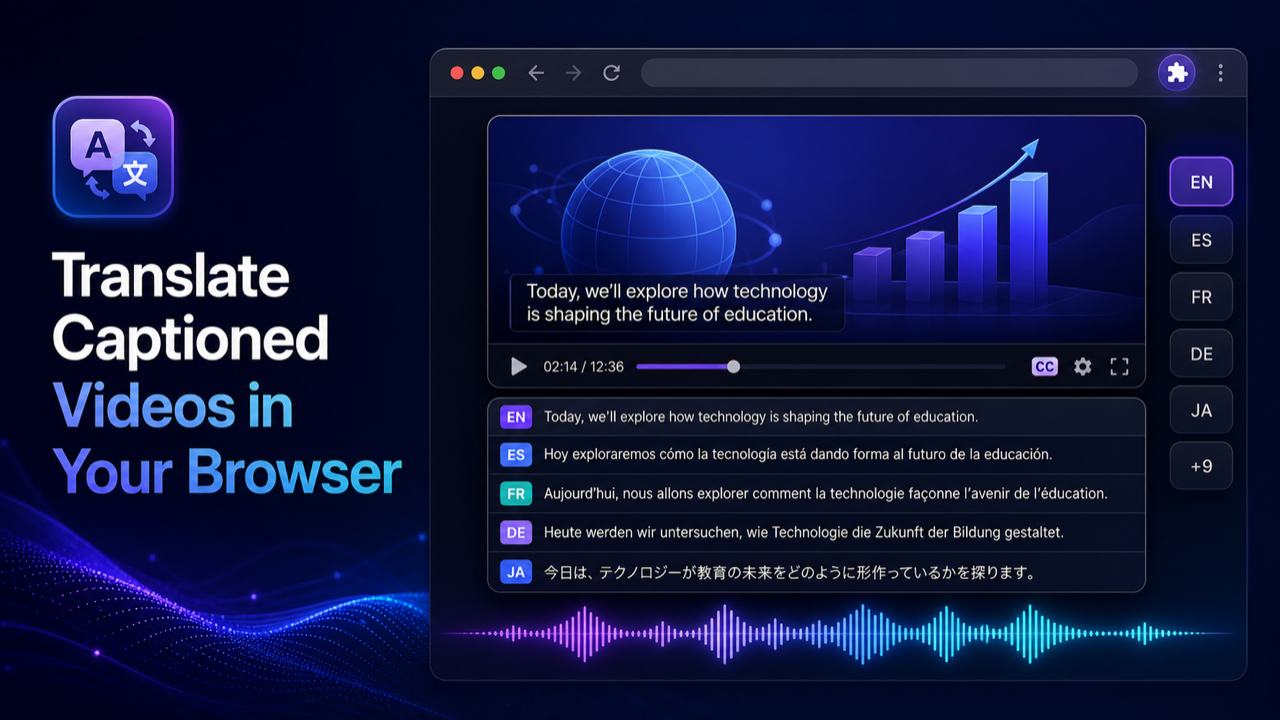
Unlimited Universal Video Translator is a Chrome extension that works inside the tab where the video is already playing. It reads the video's existing caption track, translates it, and either shows translated subtitles or plays AI text-to-speech over the original audio, timed to the captions. It is free to start with a paid unlimited tier.
Two boundaries matter for anyone coming from the Android question. It runs only on desktop Chrome, for the reasons in the extension section above. And it needs a caption track: a video with no captions does not work, because the extension translates text, it does not transcribe audio. It also does not clone the speaker's voice, sync lips, import or export subtitle files, or render a downloadable translated video. For a walkthrough of the desktop flow see how to translate a video, and for the YouTube-specific version see the Chrome extension to translate YouTube videos.
If your daily viewing is on the phone and the desktop is an occasional thing, the honest recommendation is: use auto-translated captions in the app on the phone, and open the same lecture on a laptop when you want to hear it dubbed.
Best voice translator app for android: what those apps are for
The query "best voice translator app for android" is a speech-translation query, and the apps that answer it are built for live conversation: you speak into the phone, the other person hears or reads the translation, they reply, and so on.
People do try to point one at a video. Put the phone near a laptop speaker, press the microphone button, and let it listen. The failure mode is predictable. The app has to detect the end of an utterance before it translates, so the output arrives a sentence or two behind the video and never lines up with what is on screen. Speaker audio through a phone microphone is worse than direct speech, so recognition errors go up, and every recognition error becomes a translation error. Background music, cross-talk, and technical vocabulary in a lecture make it worse still. You end up with a delayed, partly wrong transcript that you have to read while also trying to watch.
I am not going to recommend a product in this category, because the category is the wrong tool for video. For a conversation across a counter, a conversation app is the right choice; for a captioned video, use the caption path above.
Related guides
- How to translate a video
- Google Translate for video: what it does and does not do
- Real-time video translator: what "real time" really means
- Video translator Chrome extension
- Best video translator app
- How to translate a video on iPhone
Frequently asked questions
Does Android have a built-in live video translator?
Not for the soundtrack of a video playing in another app. Android phone makers ship live translation for phone calls, chat messages, and text on screen. Where a supported app already shows captions, some devices can translate that caption text, but that is text output, not a dubbed voice.
Can I run a Chrome extension in Chrome for Android?
No. Chrome for Android has never supported extensions. Kiwi Browser, the old workaround, was discontinued in January 2025 and pulled from Google Play. Edge for Android loads extensions only in the Canary channel and only from the Edge Add-ons store, so a Chrome Web Store extension cannot be installed there either.
Is there an APK that translates any video on Android?
No APK gets around the platform limits. Chrome for Android does not load extensions regardless of what you install, and no app can capture another app's protected audio. An unreviewed APK asking for screen capture, audio capture, overlay, and accessibility permissions is a security risk, not a workaround.
How do I get translated subtitles in the YouTube app on my phone?
Tap the CC icon on the player, then Captions, then Auto-translate, then choose your language. The option appears only when the video has a caption track, including an auto-generated one. The result is translated text over the original audio.
Can a voice translator app translate a video if I hold the phone near the speaker?
It will produce something, but the output lags a sentence or more behind the video and recognition errors from speaker audio turn into translation errors. Conversation apps are designed for two people taking turns, not a continuous soundtrack.
What is the way to get a dubbed voice for a captioned video?
Open the video in desktop Chrome and use a caption-based translation extension such as Unlimited Universal Video Translator. It translates the existing caption track and plays AI text-to-speech over the original audio in the same tab. It does not work on phones and it needs the video to have captions.