
How to Translate a Video on iPhone: Captions, On-Screen Text, and What a Phone Cannot Do
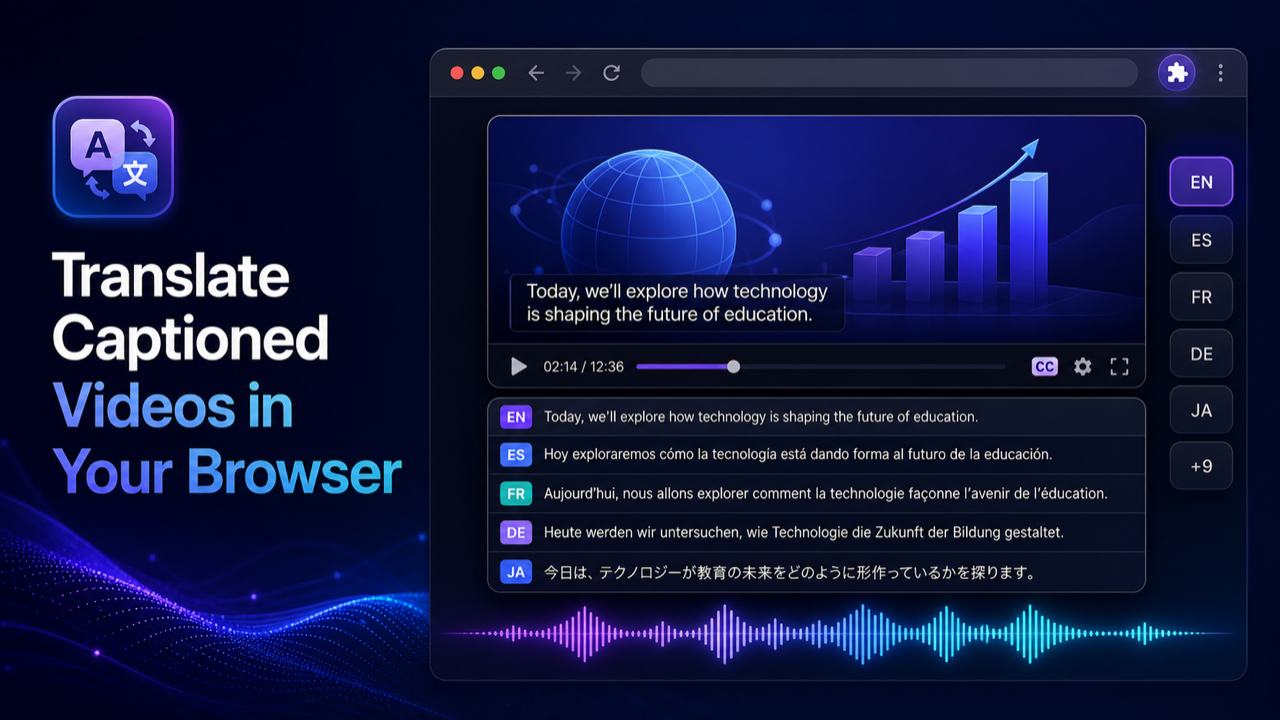
If you want to know how to translate a video on iphone, here is the short version before the steps. On an iPhone you have two families of methods that work well: translating the video's caption track, and translating text that is visible in the picture. Both are built into iOS or into the apps you already use. What you don't have is a way to install a Chrome Web Store extension, so the in-tab dubbing extension I work on, Unlimited Universal Video Translator, runs on desktop Chrome only. I'll say that once here and come back to it only at the end. On a phone, "translate a video" almost always means "translate the captions" or "translate the words on screen," and nothing native on iOS replaces the speaker's voice with a synthetic one. Keep that in mind and the choice of method gets easy.
Method 1: auto-translate the captions inside the app you are already watching in
This is the method most people are looking for, and in the YouTube app it takes four taps.
- Open the video in the YouTube app and tap the screen so the player controls appear.
- Tap the CC icon to turn captions on.
- Tap Captions in the menu, then Auto-translate.
- Pick your language. The captions switch to that language while the video keeps playing.
The catch, and it decides whether this works at all: Auto-translate appears only when the video has a caption track. An auto-generated track counts, so most spoken-word YouTube videos qualify. If the CC icon does nothing, or the Captions menu has no Auto-translate entry, the uploader has no captions and YouTube has not generated any. There is nothing on the phone that will fix that for you. The audio stays untranslated and so does the screen.
What you get is machine-translated subtitles over the original audio. Quality tracks the quality of the source captions: an auto-generated English track with a few misheard words will carry those errors straight into the translation. For a lecture or a tutorial that's usually fine. For a fast conversation with slang, expect a couple of odd lines per minute. Course apps that let you switch subtitle language work the same way: the app swaps a text track it already has and never listens to the audio.
Method 2: iOS generated and translated subtitles during playback
Apple documents that iOS can generate synced subtitles while a video plays in supported apps, and can translate existing captions on the device when you have more than one preferred language set. In practice that means two things.
First, in a supported app, iOS can put a subtitle line on screen for spoken video that has no captions of its own. This is the one place where the phone works from the audio rather than from a text track. Second, if the video already has captions in a language you don't read, iOS can translate those captions into one of your preferred languages, on device.
Before you rely on it, check three things:
- The app you're watching in has to support the feature. This is a per-app capability, so it may work in one player and simply be absent in another. Apple's own documentation is the place to confirm the current list rather than a screenshot from a forum.
- Your preferred languages list has to include more than one language. The translation option keys off that. If your phone only knows about English, there is nothing to translate into.
- The output is text. iOS translates captions and text. It does not dub. The speaker's voice stays exactly as recorded, and you read the translation at the bottom of the screen.
That third point is the one people miss. If your goal is to listen to a Spanish video in English while your hands are busy, this method won't get you there. It gets you readable subtitles, which for most short videos is enough.
Method 3: translate the text in the picture with Live Text or the Translate app
Some videos carry the important information as text burned into the frame: a slide in a recorded talk, a whiteboard, a recipe overlay, a street sign in travel footage, a product label. Captions don't cover any of that, and neither does audio dubbing. On an iPhone the path is to freeze a frame and treat it as a photo.
- Pause the video on the frame you need.
- Take a screenshot, or use Live Text directly on the paused frame where the app allows it.
- Long-press the text, or use the text-selection control, and choose Translate.
The Translate app does the same job if you'd rather open the screenshot there. Either way you get a translation of the printed text in that one frame.
Limits to be honest about: this touches only the words you can see, one frame at a time. It never hears the speech. A ten-minute lecture with thirty slides means thirty pauses. Small, blurred or stylized fonts get misread, and the translation inherits the misread. It is the only route for on-screen text on a phone, though, and for a single slide or a sign it is quick.
Method 4: Safari Web Extensions, the only extension mechanism iOS has
People arrive at this page after finding a Chrome extension that translates video and wondering whether it will install on their iPhone. It won't, and the reason is structural rather than a missing feature.
Chrome on iOS is built on WebKit, Apple's browser engine, and it supports no extensions at all. There is no Chrome Web Store on an iPhone and nothing to install into. The only extension mechanism iOS has is Safari Web Extensions, which are packaged inside an app and installed from the App Store. A listing on the Chrome Web Store is not one of those, so it can't be loaded into Safari either.
If a Safari Web Extension for video translation exists, it will be an App Store app that adds itself to Safari, bound by the same rules as everything else on the phone: it can work with captions and page text, and it can't render a dubbed video file. I'm not recommending one because I can't vouch for any of them. The two questions worth asking of any such extension are whether it needs a caption track to exist, and whether it produces text only or also a synthetic voice.
Method 5: watch on a desktop browser when you actually need dubbing
When the thing you want is to hear the video in your language, and not to read it, the honest answer is that this happens on a computer today. In-tab translation lives in desktop browsers because an extension can sit next to the player, read the caption track as it streams, translate it and speak it in time with playback.
That's what the Unlimited Universal Video Translator does on desktop Chrome: it reads the video's existing caption track, translates it, then plays AI text-to-speech dubbing over the original audio and shows translated subtitles, inside the tab where the video is already playing. The same caveat applies as everywhere else in this guide: the video has to have a caption track.
So for a long lecture or a course you'll watch repeatedly, send yourself the link and watch it on a laptop with the extension when you want the dubbed version. For a two-minute clip on the bus, Method 1 on the phone is the right tool and you'll be done before the laptop boots.
Which method fits what you have
The methods above don't compete. They cover different inputs, and the fastest way to pick is to ask what the video contains that you can't understand.
Speech, in a video with captions. Method 1 if the app supports auto-translate, Method 2 if it doesn't but the app supports iOS subtitle translation. Both give you translated text. Neither gives you a translated voice. For a translated voice, Method 5 on a desktop.
Speech, in a video with no captions. Method 2 is your only on-phone hope, and only in an app that supports generated subtitles. A desktop extension that reads captions won't help either, since there are no captions to read.
Text on screen. Method 3, frame by frame. Nothing else reaches burned-in text.
A file you recorded yourself. A camera-roll clip has no caption track, so Methods 1 and 5 have nothing to work with. Method 2 applies only in an app that supports generated subtitles, and Method 3 works on any frame you pause. Getting the clip dubbed into another language as a new file is a rendering job done by a server that takes an upload and returns a video. An iPhone doesn't do that natively, and neither does my extension.
What is simply not available on a phone today. Installing a Chrome extension. Hearing a synthetic voice speak the translation over a video in the YouTube app. Translating speech that has no caption track in an app without generated subtitles. When a page promises any of these for iPhone, look for what it actually does under the hood, which is usually upload-and-wait or captions-only.
Best voice translation app for iphone: why that is a different question
Searches for the best voice translation app for iphone pull up live speech translators: you talk into the phone, the other person hears or reads the translation, they reply, and so on. Those are conversation tools. They're built for two people in the same room taking turns, with pauses between utterances that the app uses to decide when one sentence ends and the next begins.
Pointing one at a video's soundtrack, by holding the phone up to a speaker, produces a poor result for reasons that have nothing to do with which app you picked. Video speech doesn't pause for the translator. Sentences run together, background music sits under the voice, and the app has no way to know where a line ends, so it chops the stream at arbitrary points and translates fragments. The text arrives late and out of step with the picture, because the app must hear a chunk before it can translate it. Names, jargon and anything spoken quickly come through garbled, and the errors compound since each fragment loses the context of the one before. On top of that, the phone's microphone is hearing room echo and the speaker's frequency response, not the clean audio the video actually contains.
Caption-based translation avoids every one of those problems because the words are already text, already segmented into lines, already timed to the video. That is why the methods earlier on this page all start from captions. A voice translation app is the right tool for a market stall or a taxi. For a video, use the captions.
Related guides
- How to translate a video covers the full set of routes on every platform, from captions to rendered dubbing.
- Android live translate video is the same honest walkthrough for the other phone, where the extension situation is different but the outcome is similar.
- Video translator app explains what "app" means across phone, desktop and browser, and which architecture does what.
- Translate text in video goes deeper on burned-in text and why OCR and captions are separate problems.
- YouTube video translator covers the desktop side of translating YouTube during playback.
- Video translator Chrome extension explains what an in-tab extension can and cannot read from a page.
Frequently asked questions
Can I install a Chrome extension on my iPhone to translate videos?
No. Chrome on iOS runs on WebKit and supports no extensions, and there is no Chrome Web Store to install from on the phone. The only extension mechanism iOS has is Safari Web Extensions from the App Store, and a Chrome Web Store listing is not one of those.
How do I translate a YouTube video on iPhone?
Tap the CC icon in the YouTube app, then Captions, then Auto-translate, then pick your language. The option appears only when the video has a caption track, including an auto-generated one. You'll get translated subtitles; the audio stays in the original language.
Can my iPhone dub a video into my language with a voice?
Not natively. iOS can generate and translate subtitles during playback in supported apps, and it can translate text in a paused frame, but both produce text. Hearing a synthetic voice speak the translation over a playing video is something that happens in a desktop browser today.
How do I translate text that is written on the screen in a video?
Pause on the frame, take a screenshot or use Live Text on the paused frame, select the text and choose Translate, or open the screenshot in the Translate app. This covers only the visible words in that frame, one frame at a time, and does nothing for the speech.
Why does iOS subtitle translation not show up for me?
Two common causes. The app you're watching in may not support the feature, since it is per-app. Or your preferred languages list contains only one language, and Apple ties caption translation to having more than one set. Check both before assuming the feature is missing.
What about a video I recorded myself on the iPhone?
A camera-roll clip has no caption track, so caption-based methods have nothing to read. You can translate any on-screen text with Live Text, and a supported app may generate subtitles for the speech. Producing a dubbed copy of the file is a server-side rendering job, not something the phone does on its own.