
Telegram Video Translator: What Works for Files, Channels and Voice Notes
Anyone searching for a telegram video translator usually has a file in front of them. Someone sent it in a chat, or a channel admin uploaded it, and files like that rarely carry a caption track. Most browser translation tools, mine included, work by reading a caption track and translating it, so on a typical Telegram video they have nothing to start from. Telegram is also not on the list of platforms my extension has been tested on, and I will not promise it works there. The useful question is which kind of Telegram video you are looking at, because the answer changes the route.
Three places a Telegram video can live
The most common is a file in a chat. A friend or a group member sends you an .mp4 and Telegram plays it inline with its own player. You get the picture and the audio. If there are subtitles, someone burned them into the picture before sending, and burned-in text is part of the image, which a caption reader cannot see.
A channel post works the same way underneath: the admin uploaded a file and every subscriber gets a copy. When a channel reposts a clip from YouTube or TikTok, the repost is a new video file, so the captions that lived on the original platform do not come along.
The third case is a link shown as a preview. Someone pastes a YouTube, TikTok or Instagram link and Telegram renders a card, sometimes with an embedded player. Here the video is still hosted on the other platform, with whatever captions it has there, so open the link in your browser and translate it on that site. For YouTube, the YouTube video translator guide covers both YouTube's built-in auto-translate and extension dubbing. There are separate guides for Instagram and TikTok video.
You can tell the cases apart in a few seconds. A link post has a clickable URL and a title pulled from another site. A file just shows a play button, a file size and a duration.
Telegram Web versus the desktop and mobile apps
A Chrome extension runs inside Chrome and nowhere else, which rules out most of the places people actually watch Telegram.
The Telegram desktop app for Windows and macOS is a separate program, not a web page, so no browser extension can reach into it. The Android and iOS apps are the same story, and my extensions do not run on phones anyway. That leaves Telegram Web, the browser version at web.telegram.org. It is the only place where a browser extension is even a candidate.
Being in a browser does not settle it, though. The extension still needs a caption track attached to the video element, and a file someone uploaded to a chat almost never has one. I have not tested Telegram Web and do not list it as supported.
What to do when the video is a file
A plain file with no captions needs speech recognition, and that means a different kind of tool. Download the video from Telegram to your computer, then use a service that takes a file, transcribes the speech, translates the transcript and gives you subtitles or a dubbed file back. Transcription is where the work and the cost sit, and these services usually charge per minute of video. The MP4 translator guide walks through how that pipeline works and what to check before you upload. If the video came from a channel, check that the channel allows reuse of what it posts before you download it.
The other route is to ask where the video came from. A lot of video in Telegram started somewhere else: a YouTube lecture, a TikTok, a conference talk. The sender or the channel admin may have the original link, and the original may have proper captions, sometimes uploaded by the creator. Translating from real captions beats transcribing a re-encoded file, because speech recognition on compressed audio makes mistakes and the translation then carries those mistakes over as if they were correct.
For a broader overview of both approaches, how to translate a video compares file tools and in-browser tools side by side.
Voice messages and video messages
Some people who search for this mean something smaller: a voice message, or one of Telegram's round video messages, recorded in a language they do not speak. These are short recordings made on someone's phone with no captions of any kind, so a caption-based extension has nothing to read. They need speech-to-text first and translation second.
Telegram has added its own transcription for voice and video messages in its apps, and which accounts can use it has changed over time. I am not going to describe menus or plans that I cannot check against your version of the app. Look for a transcription option on the message itself, and if you get text, you can copy it into any text translator. If your app does not offer it, the fallback is to save the recording and use a transcription tool, the same route as a longer file. The translate video to text guide explains that step.
Where my extension fits
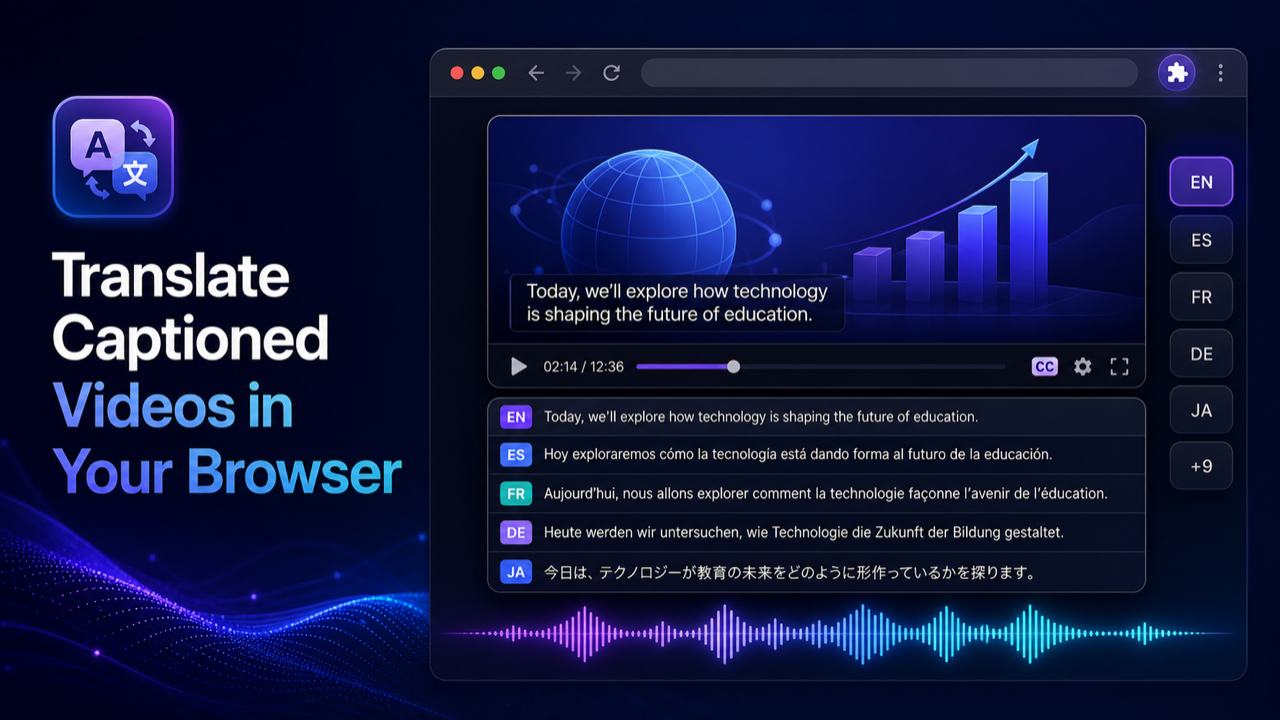
I make Unlimited Universal Video Translator, a Chrome extension for desktop Chrome. It reads the caption track of a video playing in the tab, translates it, and plays AI dubbing over the original audio, shows translated subtitles, or both. It does not transcribe audio, open local files, work in the Telegram apps, or produce a translated file you can download.
The platforms it has been tested on and works with are Udemy, Coursera, YouTube, YouTube Shorts, edX, TikTok, TED, Vimeo, Khan Academy, gamedev.tv, Zenva and Domestika. Many other captioned HTML5 players may also work. Telegram is not on that list. It is free to start, with a paid tier for unlimited use. If you want to know how extensions of this kind work in general, the video translator extension guide covers it.
In a Telegram context, that leaves the link case: someone shares a YouTube or TikTok video, you open it on that site in Chrome, and translate it there.
Related guides
- MP4 translator: a file on disk or a video in a tab
- YouTube video translator
- How to translate a Facebook video
- Translate video to text
- Video audio translator
Frequently asked questions
Is there a telegram video translator that works inside the Telegram app?
Not a browser extension, because the Telegram desktop and mobile apps are not browsers. Anything that translates a video inside the app itself would have to be built into Telegram. For files, the practical route is to save the video and use a file-based translator.
Why doesn't a caption-based translator work on most Telegram videos?
Because most Telegram videos are uploaded files without a caption track. A caption-based tool translates existing text and does not listen to the audio. With no track attached, there is no text to work from.
Can I translate a Telegram voice message?
It needs to be turned into text first. Telegram has its own transcription for voice and video messages in some versions and for some accounts, so check the message for that option. If you get a transcript, paste it into a text translator.
Does Telegram Web work better than the app for translation?
It is the only version where a Chrome extension can run at all. That does not make it work: the video still needs a caption track, and uploaded files rarely have one. Telegram Web is not in my extension's tested list.
What if the Telegram post is a YouTube link?
Then it is a YouTube video, and you should open it on YouTube. YouTube's own auto-translate works on videos with captions, and a YouTube extension can add dubbing on top.